sea bass
Jump aboard for a family friendly fishing charter experience of a lifetime.
Appearance
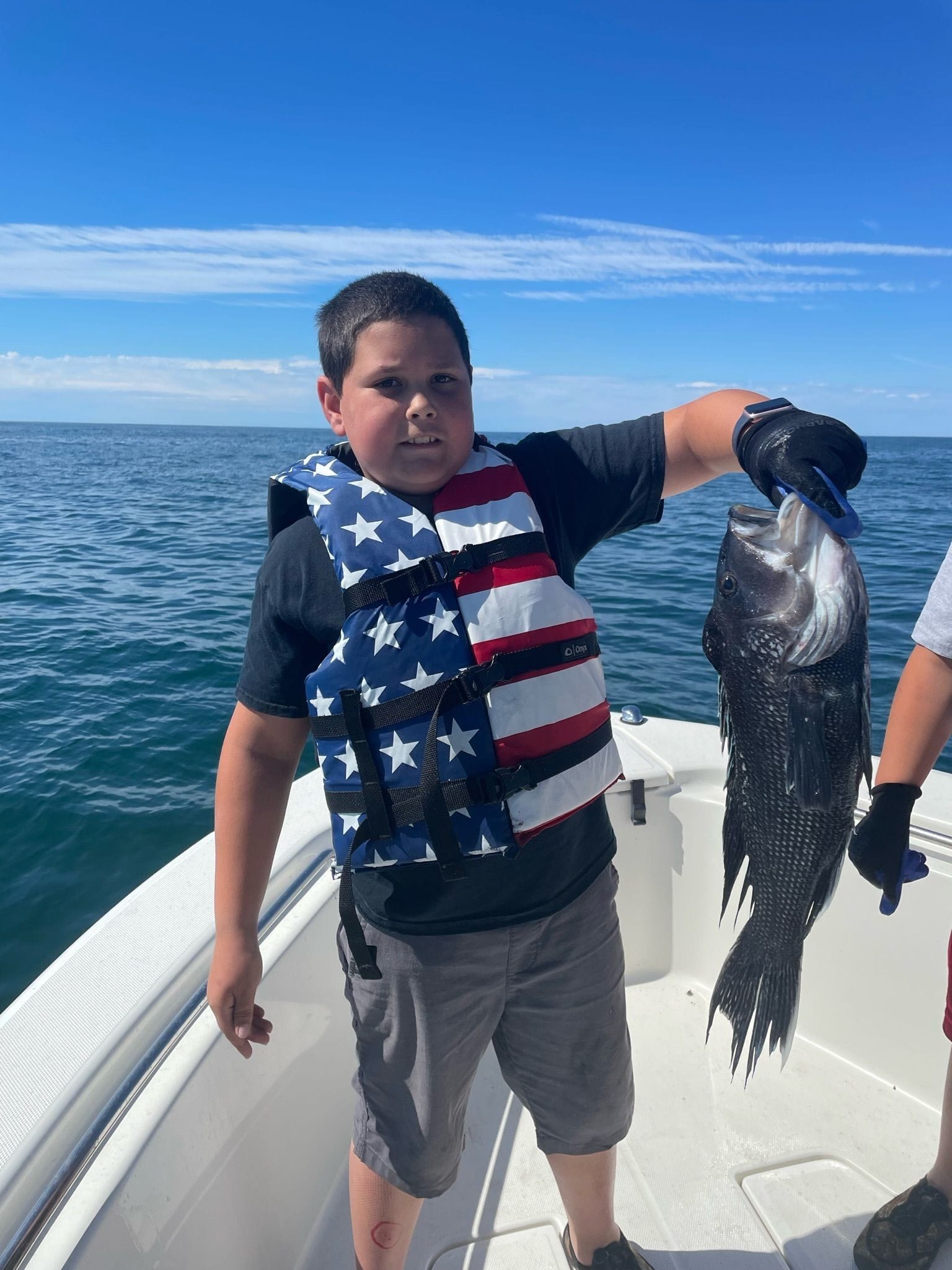
Black sea bass are stout fish with a long dorsal fin and large pectoral and pelvic fins. The dorsal fin has a spiny front section and a soft-rayed rear section, featuring white spots and bands. Their tails are rounded, sometimes with a long streamer on the top edge. Their body color ranges from blackish to grayish, with white centers on the scales. During spawning, dominant males turn bright blue and develop a head hump. Juveniles are brown with a dark lateral stripe. They can grow up to 25 inches and over 8 pounds, though most are under 4 pounds.
Habitat
In Massachusetts, black sea bass were traditionally found from Cape Cod to North Carolina, but the Gulf of Maine has recently become suitable due to warming waters. These migratory fish winter in deep waters off the mid-Atlantic and move northward to Massachusetts around May. Adults settle over rocky bottoms or structures in waters less than 150 feet deep. They're prevalent in Massachusetts until October, especially in Buzzards Bay and Nantucket and Vineyard Sounds. Juveniles prefer estuaries for feeding and protection.
Life History
Black sea bass are protogynous hermaphrodites, starting as females and often changing to males between 9–13 inches. This transition occurs in fall and winter after spawning, likely triggered by visual cues. They mature quickly, reaching sexual maturity at 2–5 years (8–14 inches). Dominant males form harems, defending their territory, while subordinate males resemble females until they can assert dominance. Spawning occurs in late spring and early summer in shallow waters. Large females can produce up to half a million eggs. The eggs float for a few days before hatching into larvae that settle nearshore. Young juveniles migrate to estuaries, growing and developing over the summer. Black sea bass are aggressive feeders, consuming small fish, crustaceans, and squid whole. They can live 10–12 years.
Black sea bass are stout fish with a long dorsal fin and large pectoral and pelvic fins. The dorsal fin has a spiny front section and a soft-rayed rear section, featuring white spots and bands. Their tails are rounded, sometimes with a long streamer on the top edge. Their body color ranges from blackish to grayish, with white centers on the scales. During spawning, dominant males turn bright blue and develop a head hump. Juveniles are brown with a dark lateral stripe. They can grow up to 25 inches and over 8 pounds, though most are under 4 pounds.
Habitat
In Massachusetts, black sea bass were traditionally found from Cape Cod to North Carolina, but the Gulf of Maine has recently become suitable due to warming waters. These migratory fish winter in deep waters off the mid-Atlantic and move northward to Massachusetts around May. Adults settle over rocky bottoms or structures in waters less than 150 feet deep. They're prevalent in Massachusetts until October, especially in Buzzards Bay and Nantucket and Vineyard Sounds. Juveniles prefer estuaries for feeding and protection.
Life History
Black sea bass are protogynous hermaphrodites, starting as females and often changing to males between 9–13 inches. This transition occurs in fall and winter after spawning, likely triggered by visual cues. They mature quickly, reaching sexual maturity at 2–5 years (8–14 inches). Dominant males form harems, defending their territory, while subordinate males resemble females until they can assert dominance. Spawning occurs in late spring and early summer in shallow waters. Large females can produce up to half a million eggs. The eggs float for a few days before hatching into larvae that settle nearshore. Young juveniles migrate to estuaries, growing and developing over the summer. Black sea bass are aggressive feeders, consuming small fish, crustaceans, and squid whole. They can live 10–12 years.